Beyond Maqāṣid
The Juridical Grammar of Islamic Law in the Ḥanafī Tradition

Recently, I have been spending some time reading contemporary Islamic legal thinking on maqāṣid al-sharīʿah. The higher objectives of the Sharīʿah have become a dominant language through which Islamic law is now being explained. Whether discussing Islamic finance, constitutionalism, bioethics, education, environmental ethics, or public policy, contemporary scholarship increasingly frames legal reasoning in terms of justice, mercy, dignity, equality, freedom, and the preservation of religion, life, intellect, lineage, and wealth.
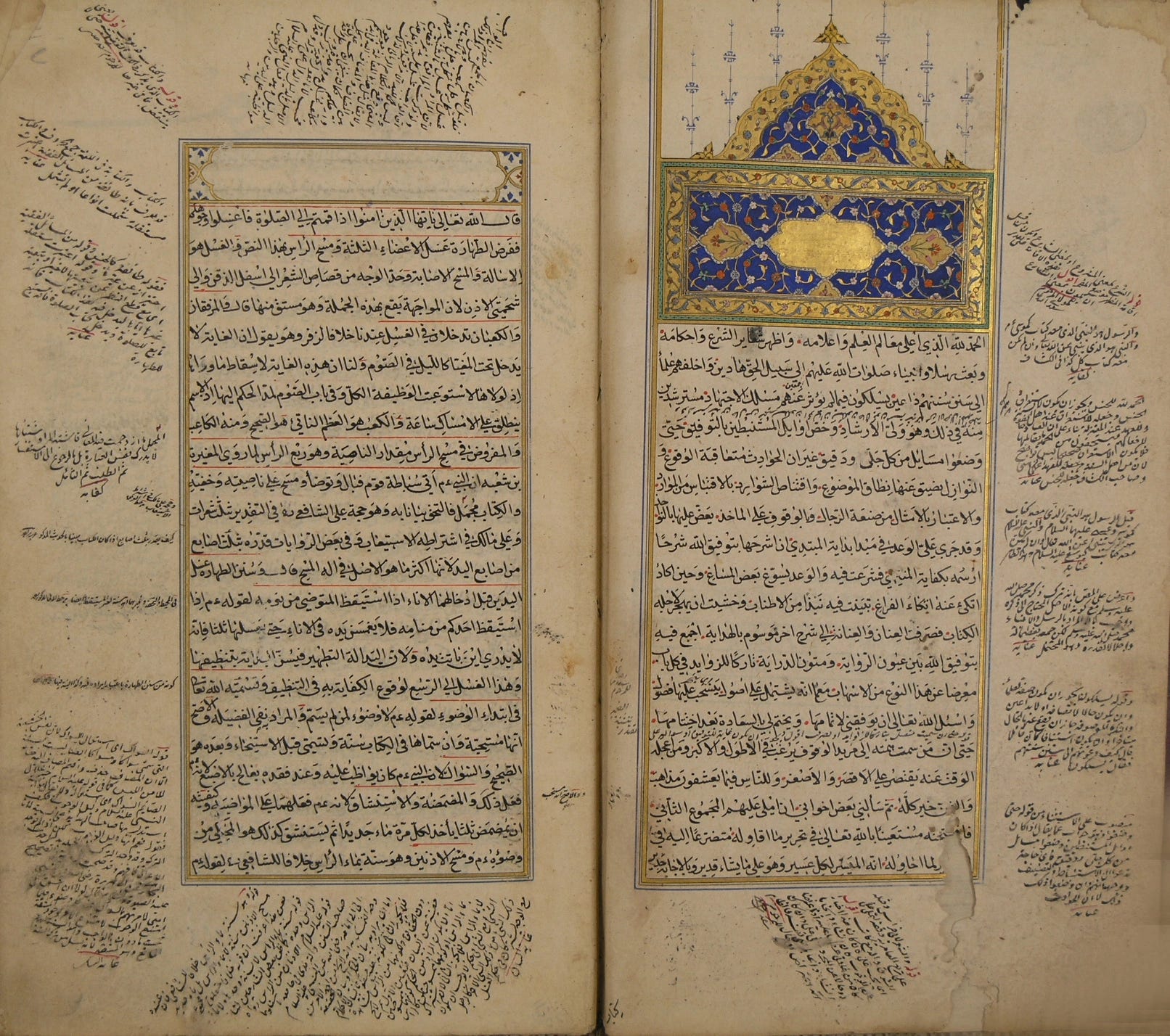
My reflection here is preliminary, and I welcome feedback and engagement.
This revival has undoubtedly restored an essential dimension of the classical legal tradition, in which the Sharīʿah is framed as a coherent legal and moral order directed towards human flourishing. Yet the remarkable success of the maqāṣid paradigm also raises an important question. Can purposes alone explain the operation of law?
I suggest (for now) that they cannot.
The difficulty lies in the tendency of some contemporary discussions to privilege the ends of the law while paying comparatively little attention to the legal architecture through which those ends are realised. Classical fiqh did not merely ask why the law exists; it also asked how it operates. It is here, I suggest, that the classical Ḥanafī theory of ḥuqūq deserves renewed attention. My argument is that the maqāṣid explain the Sharīʿah’s teleology; the Ḥanafī theory of rights explains its juridical grammar.
The classical jurists consistently maintained that divine legislation possesses intelligible purposes. Al-Ghazālī famously defined the objectives of the Sharīʿah as the preservation of religion, life, intellect, lineage, and wealth, while al-Shāṭibī transformed these observations into a comprehensive philosophy of law. Ibn ʿĀshūr later expanded the discussion, identifying broader objectives such as justice, freedom, moderation, equality, cooperation, and human dignity.
The work I have recently been studying further develops this architecture. It begins not with the five necessities but with رعاية المصالح—the preservation and cultivation of human welfare itself. From this foundation, it constructs a hierarchy comprising universal objectives (al-maqāṣid al-kulliyyah), general objectives (al-maqāṣid al-ʿāmmah), the objectives of individual fiqh chapters, and, finally, the purposes underlying every individual legal ruling.
The framework portrays Islamic law as an integrated moral system in which every legal judgement ultimately serves human welfare. But purposes do not, by themselves, produce law.
Suppose we ask a series of ordinary legal questions - these are topics I have researched separately.
Who owns a waqf after it has been dedicated?
Can the founder revoke the endowment?
Does the beneficiary own the revenue or merely possess an entitlement to receive it?
What authority belongs to the mutawallī?
Who bears liability when endowed property is damaged?
Or consider another example. Why does a wife become entitled to half of her dower (mahr) if the marriage is consummated before divorce? Why does the entire dower become due upon the death of either spouse? Why may she voluntarily remit her dower? Why may the husband increase it after the contract?
A maqāṣid analysis may correctly answer that marriage preserves lineage and safeguards the family. Yet these purposes do not explain the legal mechanics governing entitlement to the dower. The same may be said of almost every chapter of fiqh.
The idea of the preservation of wealth (ḥifẓ al-māl) does not by itself explain the rules governing possession (qabḍ), guarantees (ḍamān), agency (wakālah), partnerships (sharikah), inheritance, or trusts. The preservation of religion (ḥifẓ al-dīn) does not itself determine why intention is recommended rather than obligatory in wuḍūʾ according to the Ḥanafīs, or why forgetting the tasmiyah during slaughter differs legally from intentionally omitting it. So, purposes might explain why institutions exist. But they do not, by themselves, generate legal doctrine.
The genius of the classical Ḥanafī tradition is that rather than beginning with abstract values, the jurists characteristically begin with legal relationships. Their discussions revolve around concepts such as ḥaqq, milk, wilāyah, ḍamān, istihqāq, and ikhtiṣāṣ. These are juridical categories. They determine ownership, authority, liability, entitlement, legal standing, and responsibility.
Indeed, one might say that the Ḥanafī jurists were less concerned with identifying abstract goods than with constructing the legal architecture through which those goods become operative.
Consider waqf (again). Modern scholarship often describes the institution in terms of preserving wealth, promoting perpetual charity, or strengthening civil society. All of these observations are correct. Yet the classical jurists devoted remarkably little attention to repeating these general purposes. Instead, they debated questions such as whether ownership departs from the founder, whether the corpus remains alienable, the legal status of the beneficiaries, the powers of the mutawallī, the permissibility of istibdāl, and the administration of the endowment across successive generations (I’ll be writing more about them in due course, separately).
These discussions constitute the legal machinery through which the institution fulfils its purpose. The same phenomenon appears elsewhere, of course.
In the chapter on marriage, the jurists devote extensive discussion to guardianship, maintenance, dower, custody, inheritance, and reciprocal rights between spouses. These rules cannot be reduced to the general objective of preserving lineage. Rather, they define the juridical relationships that make family life legally intelligible.
Similarly, the chapter on sales is dominated not by abstract reflections upon commercial justice but by painstaking analyses of ownership, possession, delivery, defects, options, guarantees, and contractual authority. Once again, the objective of preserving wealth remains implicit, while the juristic effort is directed towards constructing the legal relationships through which that objective becomes effective.
Even in ritual law, the same pattern emerges. The Ḥanafī discussions of wuḍūʾ are characterised by linguistic analysis, questions of legal obligation, and precise definitions of washing, wiping, and intention. Likewise, the law of slaughter distinguishes intentional omission of the divine name from forgetfulness, not merely because ease is a maqṣad, but because different legal states produce different legal consequences.
Across the furūʿ, the same jurisprudential instinct appears repeatedly. The jurists are not simply identifying the purposes of the law. They are constructing its grammar.
This suggests a distinction that contemporary Islamic legal theory has perhaps not explored sufficiently. Another way to look at this is the questions being asked. Maqāṣid answer the question:
Why does this institution exist?
The theory of ḥuqūq answers a different question:
How does this institution operate?
The former identifies ends while the latter constructs legal relationships. The former explains why waqf preserves wealth, and the latter explains who owns the endowed property, who administers it, who benefits from it, and under what conditions those rights may be exercised or limited. The former explains why marriage preserves the family, and the latter determines the reciprocal rights and obligations that constitute marriage as a legal institution. You can now see how, without these juridical structures, the maqāṣid remain what we might call aspirations rather than enforceable realities.
None of this diminishes the importance of maqāṣid. On the contrary, the revival of the higher objectives has restored a dimension of Islamic legal thought that had often receded from view, and this helps to think about the relationship between maqāṣid and rights. It goes without saying that the classical jurists never imagined that moral purposes alone could resolve legal disputes. Nor did they suppose that technical legal rules were ends in themselves. The two belonged together. This is why I find this intersection rich: for me, the Sharīʿah possesses both a moral horizon and a legal grammar.
Great read. I agree with much of your observations and feel that the evaluative categories of the five necessities et al have been overrepresented in Maqasid discourse for a number of reasons. I also feel that there is a theological explanation to many of these positions, given that those who have theorized the five-part categorization for the most part have been Ashari scholars, who theologically are most famous for occasionalism and their denial of ta'līl. Those scholars have mainly been from the Shafi and Maliki schools. Maturidi and Athari scholarship I believe approaches the issue very differently and you have identified much of that, simply because they do not deny ta'līl. There are less in need of an abstract to explain the purposes of the law because the law itself in every instance is purposeful.
There's a lot more that could probably set about this topic but I think that your article here is a good start for theorizing how Hanafi / Maturidi scholars envisioned the Maqasid genre differently than what it has typically been characterized as.
Ustadh, this is excellent and overlaps substantially in the policy domain as well - operationalising the telos.